
Symbol of Eternity, Unity, and Divine Presence
Among all the shapes found in art, none is more universal than the circle. Without beginning or end, it has long suggested completeness, wholeness, and eternity. Across many ancient cultures, the circle represented the cycles of nature, the movement of the heavens, and the continuity of life. Early Christian thinkers did not invent these associations, but they embraced and transformed them, giving the circle a rich theological meaning centered on God, creation, and eternal life.
In Christianity, the circle came to symbolize the eternal nature of God, whose existence has neither beginning nor end. Medieval theologians often described God as perfect, complete, and infinite—qualities naturally represented by the circle’s continuous form. While the Bible does not identify the circle as an official Christian symbol, Christian art, architecture, and sacred design have employed it for centuries to express divine perfection, unity, and the promise of everlasting life. As Christianity spread throughout Europe, familiar circular forms inherited from earlier cultures—such as halos, wreaths, and solar imagery—were reinterpreted within a Christian understanding, emphasizing God’s presence rather than nature worship.
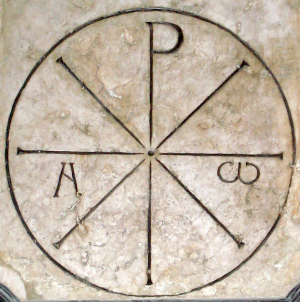
From Ancient Symbol to Christian Meaning
Long before Christianity, civilizations across Europe, the Middle East, and Asia regarded the circle as a meaningful geometric form. Ancient monuments, seasonal festivals, and decorative patterns often reflected the recurring rhythms of the sun, moon, and changing seasons.
Rather than rejecting every existing symbol, early Christians frequently gave familiar forms new meaning. This approach made it easier to communicate theological ideas while redirecting attention toward the Christian understanding of creation and redemption.
Within Christian tradition, the circle came to represent ideas such as:
- God’s eternal nature
- Divine perfection
- Unity of the Church
- Heaven and eternal life
- The unbroken covenant between God and humanity
Its simplicity allowed it to communicate profound truths without relying on written language.
The Circle in Christian Art
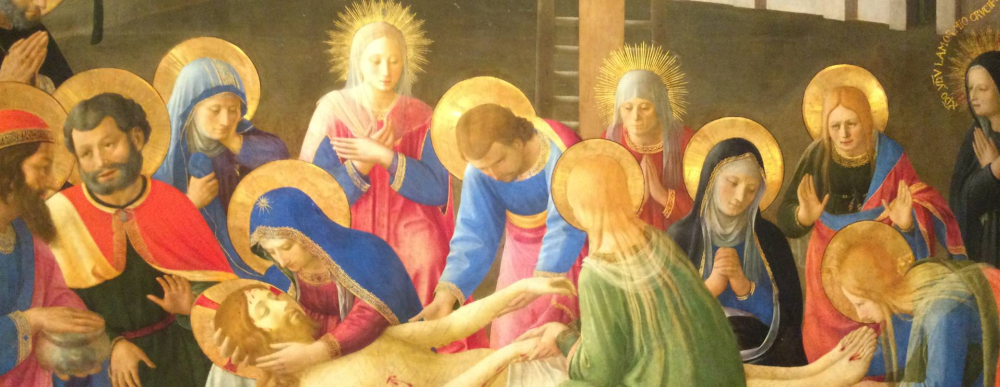
One of the most familiar uses of the circle is the halo, the circular band of light surrounding the heads of Christ, the Virgin Mary, angels, and saints. Appearing in Christian art from the fourth century onward, the halo symbolizes holiness, divine light, and participation in God’s glory.
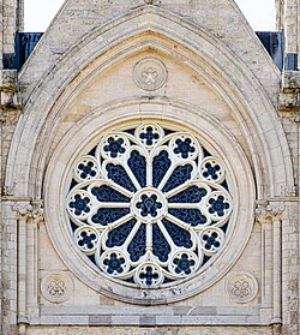
The circle also appears throughout church architecture. Rose windows, domes, baptisteries, and circular mosaics all draw upon its associations with heaven, harmony, and spiritual completeness. Medieval cathedral builders understood geometry not merely as decoration but as a reflection of divine order woven into creation itself.
Even the Christian liturgical year reflects a kind of sacred circle, returning annually through seasons of Advent, Christmas, Lent, Easter, and Pentecost, reminding believers of God’s continuing work throughout history.
Artists Who Employed the Circle as a Sacred Symbol
Many artists have used circular forms to communicate spiritual ideas, whether directly or symbolically. Among the best known are:
- Giotto di Bondone, whose frescoes frequently portray saints and Christ with luminous halos.
- Fra Angelico, whose devotional paintings combine graceful composition with radiant circular symbolism.
- Jan van Eyck, whose meticulous religious works use halos and circular motifs to emphasize sacred presence.
- Michelangelo, whose architectural and painted compositions often employ circular geometry to suggest divine harmony.
- Salvador Dalí, whose later religious works explored timeless spiritual themes through symbolic geometry and light.
Although each artist worked in a different period, all recognized the circle as a visual language capable of expressing ideas beyond literal representation.
Anonymous Traditions Around the World
The symbolic power of the circle also appears in countless works created by anonymous artisans whose names have been lost to history.
Examples include:
- Byzantine church mosaics featuring circular halos and medallions
- Medieval illuminated manuscripts decorated with circular ornament
- Celtic stone crosses incorporating ringed circles to symbolize eternity
- Ethiopian Christian icons framed by circular patterns of divine light
- Romanesque rose windows designed by anonymous cathedral craftsmen
These works remind us that Christian art has always been shaped not only by celebrated masters but also by generations of skilled artisans whose faith found expression through geometry, color, and craftsmanship.
A Shape That Continues to Speak
The enduring appeal of the circle lies in its remarkable ability to communicate profound ideas through extraordinary simplicity. Without words, it suggests unity where there is division, continuity where there is change, and eternity where human life is finite.
Contemporary artists continue to discover new possibilities in this ancient form. Whether expressed through abstraction, architecture, stained glass, sculpture, or digital media, the circle remains one of the most powerful visual symbols available to artists exploring spiritual themes.
The next time you encounter a circular form in Christian art, pause for a moment before seeing it merely as decoration. Consider how a shape with neither beginning nor end has, for centuries, helped artists express the mystery of God’s eternal presence. In its quiet simplicity, the circle continues to invite reflection on unity, wholeness, and the hope that lies at the heart of the Christian faith.
References
- Mircea Eliade. The Sacred and the Profane. Harcourt.
- Gertrud Schiller. Iconography of Christian Art. Lund Humphries.
- The Metropolitan Museum of Art. Essays on Christian Art and Byzantine Art. https://www.metmuseum.org/
- Encyclopaedia Britannica. Halo (Religious Art) and Christian Art. https://www.britannica.com/
- Robin Margaret Jensen. Understanding Early Christian Art. Routledge.