Looking Beyond the Obvious
When we first look at a painting, our attention is often drawn to its subject or its colors. Yet beneath every successful work of art lies another, less obvious element: composition. Composition is the deliberate arrangement of visual elements within an artwork. It determines where our eyes travel, what captures our attention first, and how relationships between shapes, colors, and space create meaning. Whether simple or complex, composition is one of the artist’s most powerful storytelling tools.
Composition is far more than good design. It shapes the emotional and symbolic experience of a work of art. A balanced arrangement may suggest peace and harmony, while an off-center composition can create tension or uncertainty. Large empty spaces may evoke solitude, and tightly compressed forms can communicate intimacy or conflict. Before viewers consciously interpret a painting’s subject, they often respond instinctively to its composition.
From Flat Space to the Illusion of Depth

For much of human history, artists were not primarily concerned with creating the illusion of three-dimensional space. Ancient Egyptian paintings, Byzantine icons, medieval manuscripts, and many Indigenous artistic traditions used flat (two-dimensional) composition intentionally. Figures were arranged according to spiritual or symbolic importance rather than physical realism. A king might appear much larger than other figures, not because he stood closer to the viewer, but because his role was more significant.
This approach changed dramatically during the Italian Renaissance. Artists such as Giotto began creating more convincing spatial relationships, while Filippo Brunelleschi and Leon Battista Alberti formalized the principles of linear perspective in the fifteenth century. By using converging lines and a vanishing point, artists could create the illusion of depth on a flat surface.
Perspective transformed Western painting, but it did not replace symbolic composition. Rather, artists gained another tool for directing the viewer’s attention and communicating meaning. Even when artists employ realistic perspective, composition often carries symbolic significance.
Composition as Visual Symbolism
Common compositional strategies include:
- Centered compositions suggesting importance or stability
- Circular arrangements symbolizing unity or eternity
- Triangular compositions expressing balance and spiritual harmony
- Vertical movement suggesting aspiration or transcendence
- Horizontal arrangements conveying rest, peace, or permanence
- Deliberate asymmetry creating tension or anticipation
These visual structures influence our emotional response before we consciously analyze the subject itself.
Artists Who Used Composition to Express Meaning
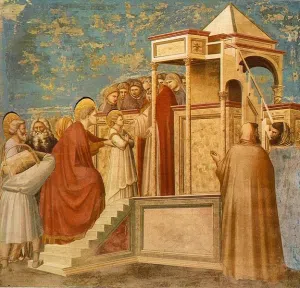
Many celebrated artists understood that composition could communicate ideas as powerfully as color or subject matter.
Among the most influential are:
- Giotto, whose carefully organized frescoes guide viewers through sacred narratives with remarkable clarity.
- Leonardo da Vinci, whose triangular composition in The Last Supper reinforces Christ’s central role while organizing the apostles into meaningful groups.
- Raphael, whose balanced compositions create visual harmony that reflects philosophical and spiritual order.
- Piet Mondrian, whose geometric grids transformed composition itself into a language of balance and universal harmony.
- Mark Rothko, whose carefully proportioned fields of color rely on compositional relationships to evoke contemplation rather than narrative.
Although their artistic styles differ greatly, each demonstrates that composition is never accidental. Every placement, proportion, and relationship contributes to the meaning of the work.
Composition Across World Traditions
The symbolic use of composition extends well beyond European art history. Anonymous artists around the world have developed compositional traditions that communicate shared beliefs and cultural values.
Examples include:
- Byzantine icons, where frontal compositions emphasize spiritual presence over physical realism.
- Tibetan Buddhist mandalas organized around sacred geometric centers.
- Islamic geometric designs built from repeating patterns that suggest infinity and divine order.
- Native American sand paintings whose balanced arrangements support ceremonial and spiritual practices.
- Australian Aboriginal paintings, where composition reflects ancestral journeys and relationships within the landscape.
These traditions remind us that composition is not simply a matter of visual organization—it is often a language of cultural memory and spiritual understanding.
Looking Beyond the Subject
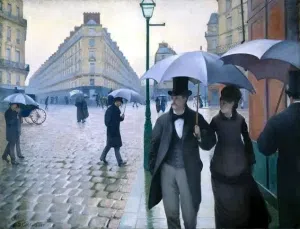
One of the most rewarding ways to experience art is to look beyond what is depicted and consider how it has been arranged. Why is one figure placed at the center while another remains near the edge? Why does one area feel calm while another creates tension? Why does your eye naturally follow a particular path across the image?
These questions reveal that composition is an active participant in the artwork’s meaning. Long before we interpret symbols or recognize historical references, composition quietly shapes our emotional response.
The next time you encounter a painting, pause for a moment before identifying its subject. Instead, notice where your eyes travel first, how the visual elements relate to one another, and what emotions the arrangement itself evokes. You may discover that composition is not merely the framework supporting the artwork—it is one of the artwork’s most eloquent forms of expression.
References
- Rudolf Arnheim. Art and Visual Perception: A Psychology of the Creative Eye.
- John Berger. Ways of Seeing.
- E. H. Gombrich. The Story of Art.
- The Metropolitan Museum of Art. Essays on Renaissance Art, Perspective, and Composition. https://www.metmuseum.org/
- National Gallery of Art. Educational resources on Renaissance perspective and composition. https://www.nga.gov/