
An Invitation to Slow Down
Not every work of art demands an immediate emotional reaction or tells a dramatic story. Some artworks ask something quieter of us: to pause, observe carefully, and reflect. This experience is often described as contemplative art—art created to encourage attentive looking, inner reflection, or a sense of stillness rather than excitement or spectacle. Whether secular or spiritual in nature, contemplative art invites viewers into a slower and more personal relationship with what they see.
Unlike terms such as Modern Art or Impressionism, contemplative art is not the name of a formal historical movement. Rather, it is a descriptive term used by museums, scholars, and artists to describe works that foster reflection and mindful engagement. The practice has deep historical roots in religious traditions around the world, where images have long supported meditation, prayer, and spiritual contemplation. Institutions including the National Gallery of Art, the Getty Museum, and scholars of visual culture recognize that works of art can serve not only as objects to be viewed, but also as invitations to sustained attention and inward reflection.

A Tradition That Spans Cultures
The impulse to create contemplative images reaches back thousands of years. Across civilizations, artists have made works intended not merely to decorate spaces but to encourage moments of quiet awareness.
Examples include:
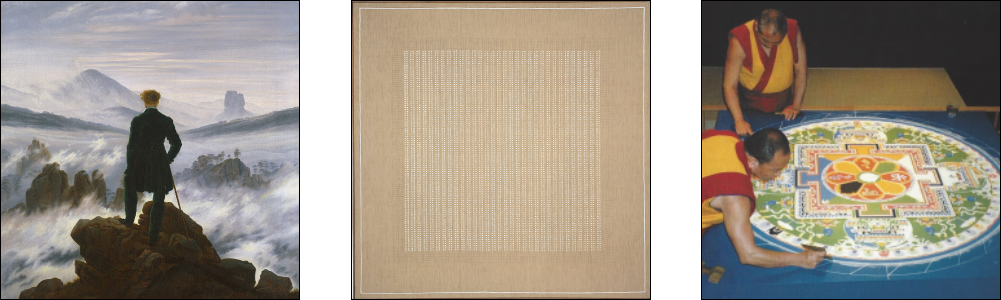
- Buddhist mandalas used in meditation
- Christian icons created for prayer and devotion
- Zen ink paintings emphasizing simplicity and presence
- Islamic geometric patterns that inspire reflection without figurative imagery
- Indigenous ceremonial objects used in spiritual practice
Although these traditions differ greatly in belief and style, they share an understanding that visual art can become a pathway to deeper awareness.
Contemplation in Western Art
Western artists have also created works that reward patient observation. Sometimes this occurs through religious subject matter, but just as often through careful composition, restrained color, or an atmosphere of silence.
Rather than overwhelming the viewer with narrative detail, contemplative works often simplify visual elements, allowing light, space, color, and form to carry emotional meaning. The result is art that unfolds gradually, revealing new relationships the longer one looks.
Artists Often Associated with Contemplative Art
Among Western artists whose work is frequently experienced as contemplative are:
- Mark Rothko
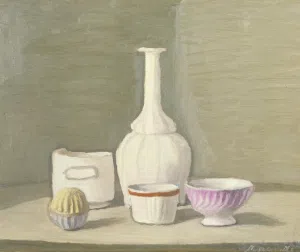
- Giorgio Morandi
- Agnes Martin
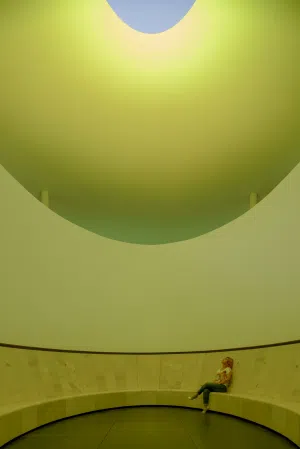
- James Turrell
- Caspar David Friedrich
Each approached contemplation differently. Rothko explored emotional depth through luminous fields of color. Morandi found quiet beauty in ordinary objects. Martin used subtle grids to evoke calm and balance. Turrell works with light itself as an artistic medium, while Friedrich’s landscapes encourage reflection on humanity’s relationship with nature and the sublime.
Why Simplicity Can Be Powerful
One of the defining characteristics of contemplative art is its willingness to leave space for the viewer. Rather than providing every answer, these works encourage personal interpretation.
Common qualities include:
- Simple compositions
- Limited color palettes
- Repetition of forms
- Balance and harmony
- Visual stillness
- Ambiguous or open-ended meaning
This simplicity is not a lack of content. Instead, it removes distractions so viewers can become more aware of their own thoughts, emotions, and perceptions while engaging with the artwork.
Contemplative Art Today
Contemplative art continues to thrive in contemporary practice. Artists working in abstraction, installation, photography, sculpture, and digital media often create environments that encourage viewers to slow their pace and experience the work over time.
In a culture filled with constant information and rapid visual stimulation, contemplative art offers something increasingly rare: permission to linger. Rather than competing for attention, it rewards patience. The longer we remain with the work, the more it has the potential to reveal.
Looking with Patience
Contemplative art reminds us that viewing can become a meaningful experience in itself. Whether expressed through an ancient Buddhist mandala, a Renaissance devotional painting, a Zen ink landscape, or a contemporary abstract composition, its purpose extends beyond appearance. It encourages us to become fully present.
The next time you encounter a work of art that seems quiet or understated, resist the urge to move on too quickly. Spend a few extra moments simply looking. You may discover that the artwork is less concerned with providing answers than with creating the space in which your own reflections can emerge. In that sense, contemplative art is not only something we see—it is something we experience.
References
- National Gallery of Art. The Sacred Made Real and educational resources on devotional and contemplative viewing. https://www.nga.gov/
- Getty Museum. Resources on sacred art, visual meditation, and slow looking. https://www.getty.edu/
- John Berger. Ways of Seeing. Penguin Books.
- Jennifer L. Roberts. The Power of Patience: Teaching Students the Value of Deceleration. Harvard Initiative for Learning and Teaching.